
What’s Wrong With My Gutters?Identifying Common Gutter Problems
Most gutter problems show up in pretty obvious ways, water going somewhere it shouldn’t, gutters pulling away from the house, or overflow during a rainstorm. The tricky part is knowing what that symptom actually means so you can fix the right thing. This guide walks through the most common problems homeowners run into and what’s likely causing each one. Once you know what you’re looking at, you can figure out whether it’s a quick fix or something that needs a pro.
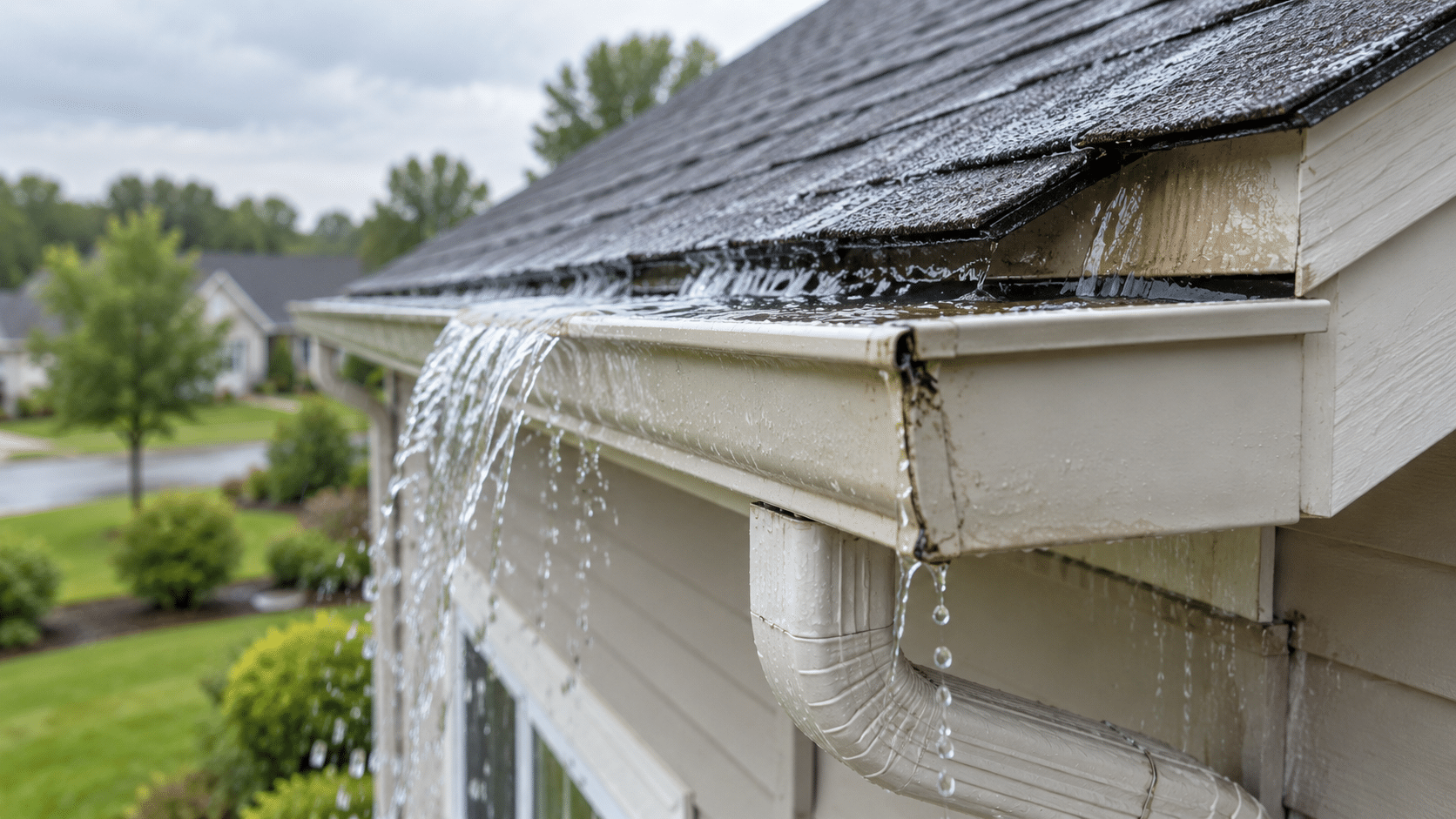
Water Is Spurting or Shooting Out of the Downspout
WH AT YOU ‘RE SEEING
During rain, water is blasting out of the downspout at high pressure, sometimes spraying sideways or shooting several feet away from the opening instead of flowing down normally.
MOST LIKELY CAUSE
The downspout is clogged. When debris builds up inside and blocks the flow, water backs up and is forced out under pressure wherever it can find an opening, usually at a joint or elbow fitting.
What to do: Clear the clog. Run a garden hose down from the top opening. If it doesn’t flush through, use a plumber’s snake or take the downspout apart at the joints to find where the blockage is sitting. Check the elbows first since that’s where leaves and debris tend to pack in.
Water Is Dripping or Slowly Leaking From the Downspout
WH AT YOU ‘RE SEEING
Water seeps or drips steadily out of the downspout joints or fittings during rain, not with force, just a slow, steady leak.
MOST LIKELY CAUSE
The downspout was not installed correctly. Downspout sections need to be lapped in the right direction so water flows down through each joint rather than sitting on a lip and leaking out. If the upper section goes inside the lower one instead of over it, water will drip out at every seam.
What to do: Take the sections apart and reassemble them so each upper piece fits over the top of the piece below it. Water should always be flowing into the next section, not into a gap. Use sheet metal screws at each joint to keep everything locked together.
Gutters Are Overflowing During Rain
WHAT YOU ‘RE SEEING
Water spills over the front edge of the gutter during a rainstorm even though there doesn’t appear to be a hole or obvious break in the system.
MOST LIKELY CA U SES
The downspout is clogged. Water can’t drain out fast enough, the gutter fills up, and the overflow goes over the front edge. The gutter itself is full of debris. Leaves, dirt, and buildup reduce how much water the channel can hold and slow down flow toward the downspout. CAUSE 3 The gutter is pitched incorrectly. If a section is level or sloping the wrong way, water pools instead of moving toward the downspout. Eventually it has nowhere to go but over the edge.
What to do: Start by gutter cleaning and downspout completely, then run a hose in it to see how the water moves. If it pools in the middle or flows the wrong direction, the pitch needs to be adjusted by repositioning the hangers. Gutters should drop about 1/4 inch for every 10 feet toward the downspout.
A Gutter Corner Is Leaking
WH AT YOU ‘RE SEEING
Water is dripping or streaming from a corner box where two sections of gutter meet, even though the rest of the gutter seems to be working fine.
MOST LIKELY CAUSES
The sealant inside the corner has worn out. Every gutter corner has an internal seam and that seam is sealed with gutter sealant. Over time it dries out, shrinks, and cracks, especially after years of freeze-thaw cycles. The sealant was never applied properly to begin with. Corners installed without enough sealant, or with the wrong product (like regular caulk instead of actual gutter sealant), will start leaking sooner than they should.
What to do: Take the corner apart if possible, scrape out the old sealant completely, clean and dry the metal, and apply fresh butyl rubber gutter sealant or a quality polyurethane gutter sealant. Don’t use regular silicone or latex caulk. It won’t flex with the metal and it’ll be leaking again by next winter.
Water Is Running Behind the Gutter and Down the Wall
WH AT YOU ‘RE SEEING
Water isn’t going into the gutter at all. Instead it’s getting behind the back of the gutter and running down the fascia board, the siding, or directly toward the foundation. This one causes rot damage fast if it isn’t caught.
MOST LIKELY CAUSES
The gutter was installed too low. The back edge of the gutter needs to sit up behind the drip edge on the roof so water flows off the roof and into the gutter. If the gutter is mounted below the drip edge, surface tension can cause the water to run from the shingles back onto the drip edge and onto the fascia and behind the gutter. There is no drip edge extension flashing installed. This flashing is installed up behind the existing drip edge and bends down into the back of the gutter, ensuring water cannot run behind the gutter even when the gutter sits below the drip edge.
What to do: This is one to take seriously. Water behind the gutter will rot a fascia board quickly and the damage often isn’t visible until it’s already bad. The gutter may need to be re-hung at the correct height so it sits behind the drip edge. If there’s no drip edge extension flashing, having one installed is the right long-term fix since it solves the problem regardless of where the gutter sits. A gutter professional or roofer can assess which situation you’re dealing with.
Not Sure What You’re Looking At?
Sometimes the best diagnosis is a second set of eyes. We’re happy to take a look and tell you exactly what’s going on.