
7 Costly Mistakes Homeowners Make When Fixing Their Gutters
Every fall, millions of homeowners grab a ladder, load up on good intentions, and head up to tackle their gutters. Some get it right. A lot of them don’t, and they end up paying for it with water-damaged fascia boards, cracked foundations, or a trip to the ER. Gutters look simple. They’re just metal channels, right? But when they’re repaired incorrectly, they can fail at the absolute worst time. Mid-storm. Dead of winter. And the damage they cause to your home’s structure can be far more expensive than just calling someone in the first place. Here are the seven most common mistakes homeowners make, and what to do instead.
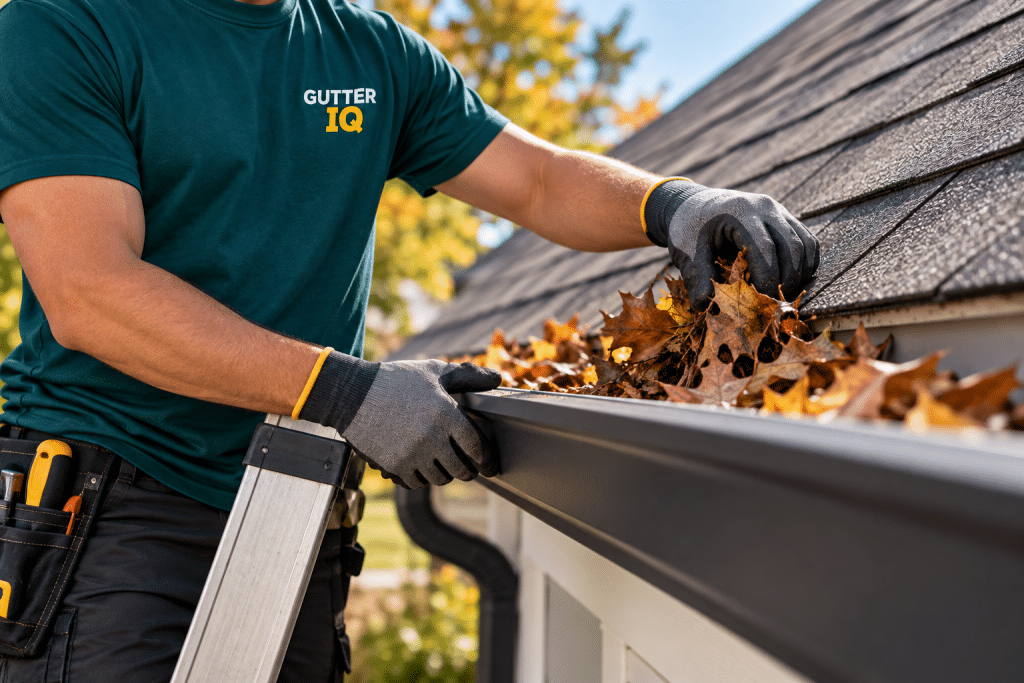
Trying to Do It All Yourself Without the Right Knowledge
The biggest mistake is assuming gutter repair is just a quick weekend chore. Cleaning them out? Sure, most people can handle that. But repairing seams, re-pitching sagging sections, re-hanging brackets, or replacing entire runs is a different thing entirely. You need to know proper slope (roughly 1/4 inch per 10 feet), correct fastener spacing, and how to account for expansion gaps. Skip that and you end up with gutters that still pool water, pull off the fascia within a season, or drip at every joint. If you’re doing more than a cleanout, do the homework first. Or just bring in someone who already knows it. Skip that and you end up with gutters that still pool water, pull off the fascia within a season, or drip at every joint. If you’re doing more than a cleanout, do the homework first. Or just bring in someone who already knows it.
Common result: A gutter repaired without proper pitch still floods your foundation. It just does it slowly enough that you don’t notice until there’s real damage.
Leaning a Ladder Directly Against the Gutter (or the Siding)
This one can get you seriously hurt. When you lean a standard extension ladder against a gutter, you’re putting hundreds of pounds of force on a metal channel that was never designed to hold a person. The gutter can collapse. The ladder can kick out from under you. And here’s the one that gets people: the ladder can slide sideways along the smooth siding or the face of the gutter, especially if there’s any slope or you shift your weight to reach something.
The fix is cheap and easy. Pick up ladder standoffs, also called ladder stabilizers. They’re the V-shaped or arm-style brackets that attach to your ladder and brace against the solid wall on either side of the gutter instead of the gutter itself. They keep the ladder from sliding sideways and take all the weight off the gutter channel. They’re usually $30 to $60 and they’re worth every cent.
Safety fact: Ladder falls send over 500,000 people to the hospital every year in the U.S. and kill roughly 300. A standoff is the cheapest insurance you can buy.
Pro tip: Set the ladder on level ground, use standoffs, and never overreach. Just move the ladder. It takes 30 seconds and might save your life.
Using Regular Caulk Instead of Gutter Sealant
Go into any hardware store and you’ll see a whole wall of caulk. Most homeowners just grab whatever’s nearby and use it on gutter seams. It holds up for a season or two and then cracks, peels, and falls apart. Here’s why that keeps happening. Gutters go through extreme temperature swings all year long. Metal expands when it’s hot and contracts when it’s cold, and it moves a lot more than most building materials.
Regular silicone or latex caulk just isn’t built for that. Actual gutter sealant (Geocel, Tremco, and similar products) is made for metal-to-metal joints. It stays flexible in the cold, bonds to aluminum, steel, and vinyl, and doesn’t crack when the gutter shifts around.
What happens: Caulked seams look totally fine in October. By February, the freeze thaw cycles have cracked them open and you’re back to leaking, often inside the wall where you can’t see it.
Use instead: Butyl rubber gutter sealant or a quality polyurethane gutter caulk. Apply it to clean, dry metal and give it the full cure time before rain hits.
Buying Thin, Cheap Gutter Materials From Big-Box Stores
Home Depot and Lowe’s are convenient and they do sell gutters. But the aluminum they stock is typically 0.019 to 0.025 inches thick, which is the thinnest stuff made. Professional-grade gutters run 0.027 to 0.032 inches. That difference is hard to see but you will absolutely feel it over time. Thin-gauge gutters dent from a falling branch or a misplaced ladder, sag between hangers, and don’t hold fasteners the way heavier material does.
They also develop holes sooner. You save maybe $40 on a 10-foot section and then spend $400 replacing rotted fascia boards two or three years later. Same goes for the cheap gutter guards, the old spike-and-ferrule hangers instead of hidden hangers, and undersized downspouts. All of it looks fine at first. All of it shows up on a contractor’s bill eventually.
The math: Professional-grade aluminum costs 20 to 40% more per foot and lasts two to three times longer. It’s really not a hard decision.
Where to buy: Roofing supply houses and specialty gutter suppliers carry heavier gauge material and proper hidden hanger systems you usually won’t find at a big-box store.
Ignoring the Downspouts and Drainage Outlets
People spend all their time on the gutter channel and forget about where the water actually goes once it leaves. A downspout that ends 6 inches from your foundation, or that dumps onto a flat patch of ground that doesn’t drain, is pointing thousands of gallons a year straight at your basement or crawlspace.
Downspouts should empty out at least 6 to 10 feet from the foundation, either through extensions or underground drains. The ground around your house needs to slope away from it, at least 6 inches of drop over 10 feet. Also worth checking: clogged or kinked downspout elbows are one of the most common reasons gutters overflow, and almost nobody looks at them during a repair job.
Real cost: Foundation waterproofing repairs run $4,000 to $10,000. Downspout extensions are $15 to $30 each.
Not Cleaning the Gutters Before Making Repairs
Trying to repair a gutter that’s packed with wet leaves and debris is a waste of time and materials. Sealant won’t bond to dirty or damp metal. Screws won’t seat right through packed-in gunk. And honestly, you probably can’t even find where the water is actually escaping from.
Clean everything out first. Remove the debris, flush the gutter with a hose to spot the leaks, and let the metal dry fully before you touch any sealant or hardware. Usually 24 to 48 hours is enough. If the aluminum is oxidized, give it a light scrub with a wire brush before sealing. That extra step makes a big difference in how long the repair actually holds.
Right order: Clean, dry, inspect, repair, then test with the hose. That’s it.
Waiting Too Long and Then Patching Instead of Replacing
Aluminum gutters last about 20 years. Steel is 15 to 20. Vinyl is 10 to 15. A lot of homeowners spend years patching the same section over and over rather than accepting that it’s just done. If you’ve got multiple patches on the same run, the gutters keep pulling away from the fascia, or you’re seeing rust and holes in several spots, that’s not a repair situation anymore. That’s a replacement.
The other part of this mistake is just waiting. A small leak left alone for one season can rot the fascia board behind it. Then the soffit. Then the roof decking underneath. What would have been a $200 gutter repair turns into a $2,000 or $5,000 carpentry job. Check your gutters at least twice a year. After the last leaves fall in autumn and again in early spring.
Rule of thumb: If you’ve fixed the same section three times, the fourth answer is replacement, not another patch.
Your Gutters Protect Everything Else
They’re not glamorous, but gutters do a lot of heavy lifting for your home. Get the materials right, use the right products, be smart on the ladder, and know when a job is bigger than a weekend project. Calling a pro when you need one is never the wrong call. Water damage is almost always more expensive than the repair you were trying to avoid.